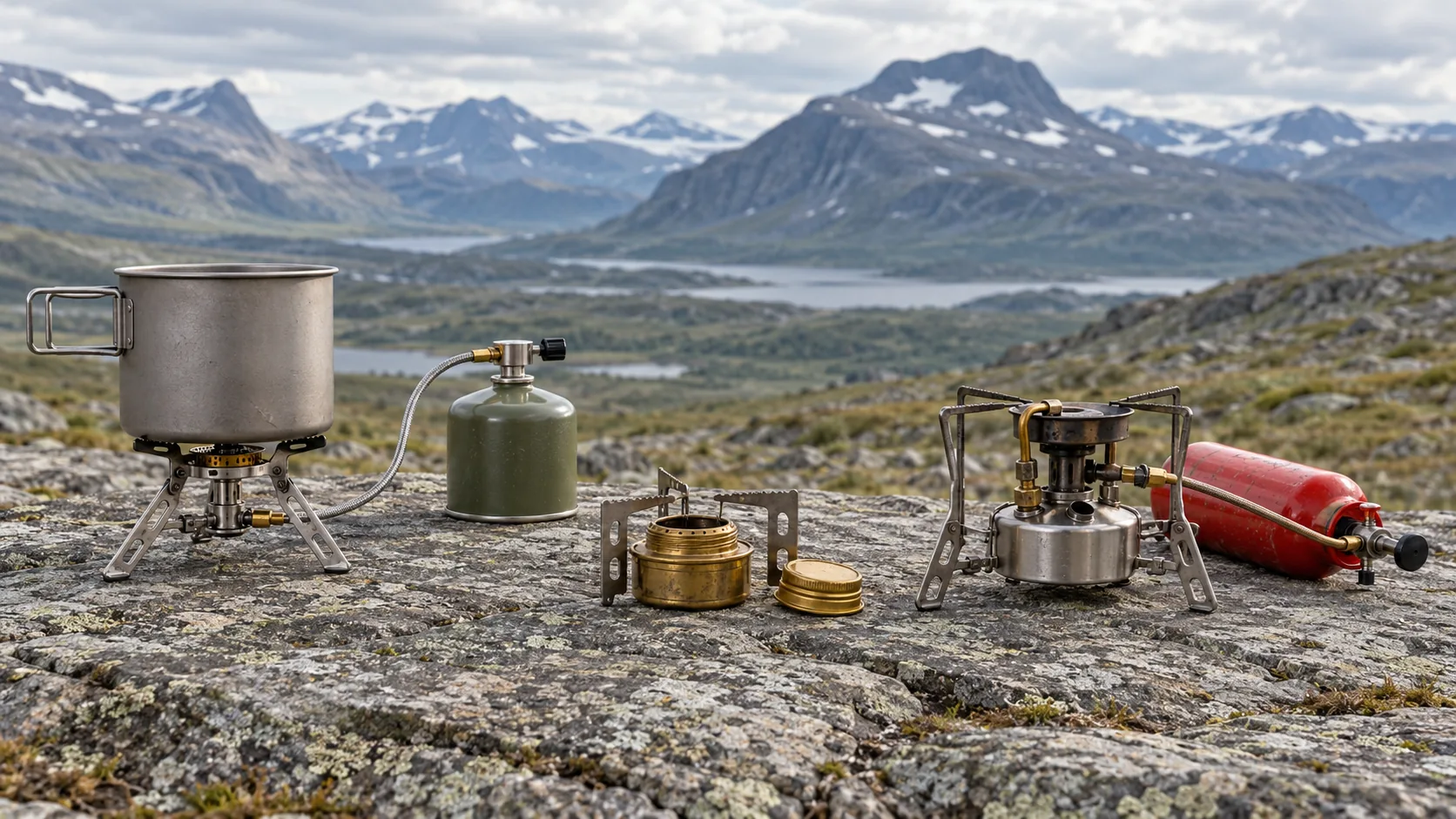
You can’t take a gas canister on a plane, in either hand luggage or hold luggage (the bags you check in). If you’re flying, buy gas when you arrive, for example around Sweden’s Sarek National Park: at Kvikkjokk Fjällstation or STF Saltoluokta. In the cold, a blend of isobutane and propane works better. At night you can put the canister in your sleeping bag, always unscrewed from the stove, but never warm it with a flame, next to a fire or in boiling water.
I use Sarek as my example of where to buy gas, but the principles apply to any route where you cook on a canister stove. In my guide to food for a week-long trek, I explain how much gas to take and how to measure your own stove’s consumption. Further down I also compare a remote canister stove with a screw-on one, and gas stoves with spirit and petrol ones.
Gas canisters on planes, ferries and trains
Gas canisters (butane, isobutane, propane) aren’t allowed on passenger flights, in either hand luggage or hold luggage. When I fly, I buy gas on arrival, and when I go by ferry and then train, I bring a canister from Poland. If you’re travelling that way, check the carriers’ terms to see if you can take one. Rules for the stove on its own, without a canister, vary between airlines, so check yours before you fly. Don’t count on a shop or hut along the route itself, because it may run out of canisters. Carry gas for the whole route from the start.
Buying gas on arrival
When you buy gas locally, check that the canister is new (a refilled canister can be dangerous), has a thread that fits your stove and contains a blend of isobutane and propane, which copes better with the cold. Because small shops can run out of canisters, phone before you set off and ask about canister size and thread type. Before you buy, see how to work out how much gas you need for a week’s trekking.
Example: Sweden, around Sarek
Around Sarek, places that sell gas include Kvikkjokk Fjällstation and STF Saltoluokta. Both are seasonal, so check when they’re open.
Gas in the cold
In the cold, choose a canister with a blend of isobutane and propane rather than butane or a mix of butane and propane, because the isobutane blend holds higher pressure at low temperatures. Pure propane, which some shop guides recommend for sub-zero temperatures, is sold in heavier-duty cylinders, not in screw-on stove canisters (standard EN 417): at 50 °C its pressure is too high for that kind of canister. I use that blend myself and it burns well for me. Even so, the blend isn’t a guarantee: the canister cools as you cook, and the propane in it gets used up faster, so in freezing conditions the flame can weaken before the gas runs out.
On cold nights I keep the canister next to me. You can also put it in your sleeping bag or a jacket pocket overnight, so the gas burns better in the morning. The canister must be unscrewed from the stove. Take it out of the sleeping bag just before you cook. While the stove is running, don’t stand the canister on snow or cold rock: put it on a piece of sleeping mat instead. Never warm a canister with a flame, next to a fire or in boiling water: manufacturers say it must not be exposed to more than about 50 °C, because it may explode or start to leak. If you smell gas, take the canister out of the tent.
Screw-on or remote canister stove
A screw-on stove fits straight onto the canister, so the burner sits right above it. A remote canister stove connects to the canister with a flexible hose: the canister stands beside the burner, not underneath it. The Soto Fusion Trek instructions say to keep the canister at least 15 cm from the burner. For ten days I take a Soto Fusion Trek (a remote canister stove) and one 450 g canister. That’s enough for me, but how much you use depends on what you cook and on the weather, so work it out using my food guide.
Stove safety
Do not use a windshield with a stove that screws straight onto the canister, unless the maker of that model expressly allows it. A canister enclosed by a windshield can overheat, which can lead to a gas leak or an explosion.
With a remote canister stove such as the Fusion Trek, never cover the canister with a windshield, stones or a board, because it can overheat and explode. At most, a windshield may go around the burner itself, and only in the way your model’s instructions describe. Soto calls the Fusion Trek burner highly wind-resistant, so you usually won’t need a windshield. Do not turn the canister upside down either, unless your stove’s instructions allow it. Soto forbids this with the Fusion Trek, because an upturned canister releases unvaporised gas, which can flare up into a large flame.
Light the stove outside, away from the tent fabric. Do not cook in the inner tent or in the porch. Burning gas in an enclosed space can cause carbon monoxide poisoning, and the flame can set the tent on fire.
A pot with a heat exchanger, the ring of fins on its base, doesn’t suit every stove. Soto prohibits using such pots with its stoves, because the combination can produce a lot of carbon monoxide. Before you buy, check the instructions for both the stove and the pot.
Alternatives to a canister: spirit and petrol
Trangia and other spirit stoves
A Trangia is a stove set with a spirit burner: you pour fuel into the brass burner and light it, with no pump and no canister. The burner has few parts, normally needs no maintenance and runs almost silently.
It’s slower than a gas stove: according to Trangia, 50 ml of fuel brings a litre of water to the boil in 10–15 minutes, and the heat is harder to adjust. The comparison below shows how much fuel it uses per litre of water. In the cold the burner gives out less heat, and Trangia suggests using a preheater at around +5 °C and below.
The fuel for a Trangia is methylated spirits, sold in Poland as denaturat and in Sweden as T-Röd or T-Tenol. In Sweden you can buy it at filling stations and in food and sports shops, among other places. Around Sarek, Kvikkjokk Fjällstation and STF Saltoluokta sell spirit for camping stoves.
In daylight a spirit flame can be almost invisible. Never top up the fuel until the flame is completely out and the burner has cooled. Trangia warns that refilling a hot burner is very dangerous and tells you to check with your hand that the flame is out and the burner has cooled. Spilt spirit burns too, so keep the fuel in a leakproof fuel bottle and fill the burner away from any flame. Only use the burner outdoors.
You can’t take fuel for a spirit stove on a plane, in either hand luggage or hold luggage. Buy fuel when you arrive.
Petrol and multi-fuel stoves
A multi-fuel stove, such as the MSR WhisperLite International or the Primus OmniFuel, draws fuel from a metal bottle that you pressurise with a pump. Before cooking you have to prime the stove: you let a little fuel out under the burner and light it, and you only open the fuel supply fully once the burner has warmed up.
In severe cold this kind of stove copes better than a canister stove, and below −22 °C Primus recommends it instead of gas. It burns best on white gas, a pure petrol made for stoves (in the UK also sold as Coleman fuel), such as Primus Power Fuel or MSR SuperFuel. Manufacturers allow ordinary unleaded petrol only in an emergency, because its additives clog the stove and are harmful to health. Do not use leaded petrol at all.
A multi-fuel stove is heavier than a gas stove: MSR lists a minimum weight of 318 g for the WhisperLite International, without the bottle. You also have to clean the jet and replace the seals every year. On paraffin (kerosene) and diesel it gives off soot: Primus, for example, describes this in the OmniFuel instructions.
When you prime it, the flame can be tall and unsteady, so do not lean over the stove, and light it well away from the tent. Do not cover the fuel bottle with a windshield or stones, because if it overheats it may explode or start to leak.
You can’t take petrol on a plane in any luggage. The stove itself and the fuel bottle can go only in hold luggage, only when completely emptied and cleaned, and only with the airline’s approval, so ask your airline before you fly.
Fuel per litre of water: a rough comparison
Manufacturers quote fuel consumption in different units: MSR says its stoves boil 16–17 litres of water on a 227 g canister, Trangia gives 50 ml of spirit per litre, and for the WhisperLite International MSR gives 100 ml of white gas for 4.4 litres. Converted to one litre of water, the figures work out like this:
| Stove | Fuel to boil 1 litre of water |
|---|---|
| Canister stove (MSR PocketRocket) | about 13–14 g of gas |
| Spirit burner (Trangia) | 50 ml of spirit |
| Petrol stove (MSR WhisperLite International) | about 23 ml of white gas |
These are manufacturers’ figures from different tests, so treat them as a rough guide rather than a basis for planning. In my food guide, I work out how much gas to take.
Before you set off
You’ll find a full kit list in my guide to what to pack for your first multi-day camping trek.
If you’d like to head into the wild with me, take a look at my expeditions or write to me.
Frequently asked questions
Can I take a gas canister on a plane?
No. Gas canisters (butane, isobutane, propane) aren’t allowed on passenger flights, in either hand luggage or hold luggage (the bags you check in). Buy gas when you arrive, and check the rules for the stove on its own with your airline.
Where can I buy gas in Sweden?
For example, around Sarek: at Kvikkjokk Fjällstation and STF Saltoluokta. Both are seasonal, and small shops can run out of canisters, so phone before you set off and ask about canister size and thread type.
Which gas canister is best in the cold?
Choose a canister with a blend of isobutane and propane rather than butane or a mix of butane and propane, because the isobutane blend holds higher pressure at low temperatures. Pure propane, which some guides recommend for sub-zero temperatures, is sold in heavier-duty cylinders, not in screw-on stove canisters (standard EN 417).
How do I keep a gas canister warm on a cold night?
You can put the canister in your sleeping bag or a jacket pocket overnight, always unscrewed from the stove. Never warm a canister with a flame, next to a fire or in boiling water, because manufacturers say it must not be exposed to more than about 50 °C. If you smell gas, take the canister out of the tent.
Can I use a windshield with a canister stove?
Do not use a windshield with a stove that screws straight onto the canister, unless the maker of that model expressly allows it. A canister enclosed by a windshield can overheat, which can lead to a gas leak or an explosion. With a remote canister stove, never cover the canister. If you use a windshield at all, put it only around the burner itself, following your model’s instructions.
Gas or spirit stove?
A gas stove boils water faster. A spirit stove such as a Trangia has few parts and runs almost silently, but loses power in the cold. In severe cold, below −22 °C, Primus recommends a multi-fuel stove.
Can I take methylated spirits or petrol on a plane?
No. Liquid fuel isn’t allowed in any luggage. An empty, cleaned stove can go only in hold luggage, and only with the airline’s approval, so ask your airline before you fly.
Back to tips