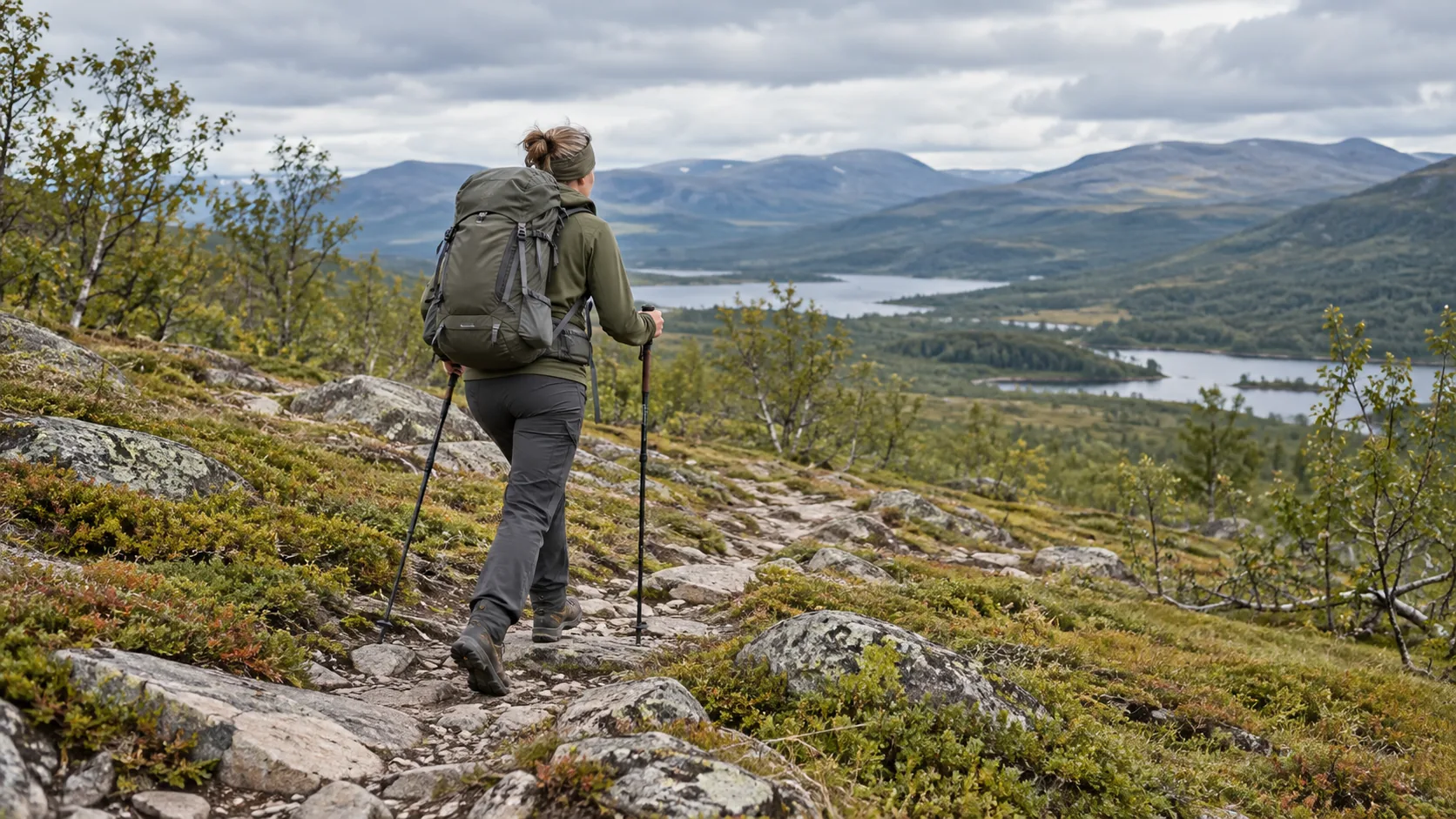
On the first day, your legs hold up. It’s the next morning, after a night in the tent, that you feel what those hours of walking under load have cost you. You pull your boots back on, shoulder your pack and set off again. Walking like that, day after day, is what you need to train for.
You build fitness for a trek gradually, increasing one thing at a time: walking time, pack weight or the difficulty of the route. Leg and balance exercises come on top of that. The sample plan below lasts eight weeks, with an overnight test run towards the end.
Before a multi-day trip, what counts is time on your feet, how well you cope with the weight of your pack and sure footing on rough ground. Your 5K time won’t tell you how your feet, shoulders and knees will feel on the second day of a trek. You can find that out beforehand, on a route close to home that you can cut short if you need to.
Start with what your route demands
Before you draw up a training plan, find out how many hours a day you’ll be walking, over what kind of ground, how much ascent and descent there will be and how much your pack will weigh at the start. Ask about rest days, too, and about escape routes: where you could leave the route early if you had to. If you’re going with a guide, talk all this through with them before you sign up.
Include food, water and your share of any group kit in your pack weight. In my guide to trekking food I work out what the food alone weighs: the worked example comes to over 9 kg for ten days without resupply, plus two spare days. For everything else that goes in your pack, see my kit list for a multi-day trek.
Give yourself time to build up
If you already walk regularly and can manage routes lasting several hours without trouble, eight weeks may be enough to get ready for walking with full kit. Your preparation combines walking, strength exercises and balance work. The outline below shows one way to spread things out, but it’s no substitute for a personalised training plan.
If you haven’t exercised for a while or you have a long-term health condition, talk to your GP before you start the plan. If you’ve had injuries in the past or something hurts when you exercise, go through your training plan with a GP or physiotherapist before you begin. An upcoming trip is no reason to rush your training while you’re in pain.
Give yourself more time if you don’t walk regularly or you’re getting back into exercise after a long break, and take it in stages:
- First, get to the starting point: walking regularly and managing routes lasting several hours without trouble.
- Then do your first overnight test runs, starting with a lighter pack.
- Once a few weekends have gone well, do a test of three days or more with a full pack.
- Save the plan in the table below for the last eight weeks before you leave.
Walk regularly and watch your pace
Each week, plan two shorter walks and one long one. To begin with, a shorter walk might last 30–45 minutes. Base the long walk on what you can already manage without getting overly tired, then lengthen it a little at a time until it comes close to a day on the route. If you only go for short strolls at the moment, don’t start with an all-day walk.
On easy walks, keep to a pace that still lets you hold a conversation. At moderate effort you can talk, but not sing. You don’t need a sports watch to check that.
Cycling or swimming can complement your training, but leave room in your diary for walking. Walks also let you test your boots, your socks and the way your pack is adjusted.
Change one thing at a time
Start with a lighter, well-fitted pack and add weight gradually. Increase only one thing each time. If you lengthen the route, add several kilograms and take on steep climbs all on one outing, it’ll be hard to tell afterwards what caused any problems.
For example, if a two-hour walk with your current pack went well, next time add a short stretch to the same route and keep the weight the same. Before you add anything else, check how you feel that evening and the next day.
Keep a simple training log. After each outing, note down:
- the date, time on your feet and distance in kilometres
- the ascent and type of terrain
- your pack weight
- any rubbing, pressure points or other aches and pains
- how you feel the next day
If joint pain keeps coming back, you start to limp or something goes numb, stop the test and find out what’s causing it. Do not try to walk it off.
Chest pain that doesn’t settle when you stop, fainting, or severe or unusual breathlessness are signs to stop exercising immediately and call for urgent medical help.
Strength and balance exercises for trekking
A simple starter set: sit-to-stands from a chair, step-ups onto a low, stable step, slow step-downs and standing on one leg next to something you can hold on to. Start without extra weight. Choose a range of motion and a number of repetitions that keep each exercise controlled and pain-free. You can practise the technique with a physiotherapist or a personal trainer.
You don’t need any equipment for the step exercises: if you haven’t got an exercise step, the bottom step of a flight of stairs will do. Once an exercise feels easy, change one thing at a time, just as with walking: a higher step or a loaded pack. Start with about 4.5 kg (10 lb) in the pack and add a little more each week until you reach roughly 80% of the weight you’ll set off with. For example, with a pack weighing 20 kg (44 lb), that’s about 16 kg (35 lb).
If you move on to harder exercises, remember that not all of them suit beginners: leave jump squats until you’ve mastered the version without the jump.
Do strength exercises twice a week, with at least one day off in between.
Here’s how I prepare myself: several times a week I go for walks of about 2–3 km, some of them with a pack. I also exercise at home, mostly my legs, doing different kinds of squats. That’s my personal routine, not a substitute for the plan in this guide.
Good balance helps on more than just rocks. On many routes without marked trails, for example in Sweden’s Sarek National Park, you’ll also have to cross rivers. I cover the technique in my guide to river crossings.
Going downhill with a pack, and using poles
On the way down, your legs have to act as brakes for your body and pack with every step. So as well as climbs, practise gentle descents. Start on firm ground, with a short stretch you can repeat without rushing. The slow step-downs described above train exactly this.
If you plan to use trekking poles, take them on your training walks. Practise adjusting their length, getting your arm rhythm right and stowing the poles when they get in the way. New kit is easier to master on a path you know.
An 8-week backpacking training plan
This plan assumes you already walk regularly. You can stretch any stage out. Only move on when you’re coping well with the current load and recovering in time for your next session.
A sample training week:
| Day | Training |
|---|---|
| Monday | Strength and balance exercises |
| Tuesday | Shorter walk |
| Wednesday | Easier day |
| Thursday | Strength and balance exercises |
| Friday | Shorter walk |
| Saturday | Long walk |
| Sunday | Easier day |
The eight-week plan:
| Period | Main focus | What to check |
|---|---|---|
| Weeks 1–2 | Regular walks with a light pack; learning the strength exercises | Do your boots and pack stay comfortable on a longer walk? |
| Weeks 3–4 | Gradually lengthening your long walk; gentle climbs and descents, on separate outings | Are you in control of your footing on descents, and do you recover by the next day? |
| Weeks 5–6 | Walking on terrain like that of your route; on other outings, pack weight gradually closer to your starting weight | Can you hold a steady pace without the weight changing the way you walk? |
| Week 7 | Overnight test with full kit: at least two days, and three or more if you can | How do the second and later days go, and have you still got the energy for camp chores after walking? |
| Week 8 | Lighter outings, rest and kit adjustments | Will you have time before you leave to rest and fix whatever came up on your test runs? |
If you’re heading into pathless country, for example in Sarek, train close to home on whatever ground comes nearest to it: rough, rocky stretches. In my guide to planning trekking stages I explain that in the heart of Sarek National Park a realistic pace is 2–3 km/h, and even less on difficult stretches. The terrain conversion figures in that guide show that boulder fields, bogs and willow scrub are much slower going than flat tundra. Ten kilometres on a wide track and the same distance over rocks are two different training sessions. I describe how to walk off-path in my guide to moving through trackless wilderness.
After a harder outing, match your next session to how quickly you recover. A week of illness or heavy fatigue may mean dropping back a stage.
How to do a trial camping weekend
Choose somewhere you’re allowed to camp and a route with an easy way back. Take the boots, socks, pack and sleeping kit you’ll be using on the trip. Only work up to your full starting weight once lighter test runs have gone well. Plan your food for the weekend as you would for the real thing. I explain how to work it out in my guide to trekking food.
On the first day, walk at the pace you plan to keep up on the trip. When you reach camp, pitch the tent, cook dinner and sort out your kit; the next day, pack up camp and walk the planned section. Don’t extend the test just to get a better result.
Short trips with one or two nights out are also a good way to try out your kit and see what walking day after day with a heavy pack is like.
When you get back, ask yourself a few questions:
- On the second day, could you walk without limping or favouring a sore leg?
- Did your boots rub, and did your pack cause numbness or pressure that didn’t go away?
- What state were your feet in after a full day, especially if your boots got wet through?
- Was there enough food, and did it sit well while you were walking?
- When you arrived, did you have the energy to set up camp, or did you need help with basic tasks?
- Did you sleep well, or do you need to change your mat, your sleeping bag or the way you camp?
- Does your pace match the route you’re planning?
A good weekend will tell you a lot, but it won’t settle whether you’ll cope with a multi-day trek. A longer trip adds changes in the weather and mounting fatigue, and you’re further from any escape route.
A test of three days or more
Once your weekends are going well, walk at least three days back to back with a full pack. I recommend this test before any longer route. A long weekend is the easiest way to fit it in. The third day will tell you more than a weekend can: whether fatigue is building up, whether your food is lasting and how your feet and shoulders stand up to the same effort several days running.
Back home, go through the same questions as after the weekend and add the results to your training log. If you’re following the plan in the table, week 7 can be this test, as long as you extend it to three days. If you’ve already done the test, repeat it in week 7 as a dress rehearsal.
Fix what your test runs revealed before you go
If something rubs, try different socks or sort out the fit of your boots. I go into more detail in my guide to choosing trekking boots. For pressure on your shoulders, check how your pack is adjusted, how the weight is distributed and how much you’re carrying in the first place. If pain keeps coming back, see a GP or physiotherapist. And if your pace turned out too slow, you may need to change the route plan or the date of the trip.
Keep the log from your most recent test runs: it’ll come in handy when you plan your next route.
If you’d like to head into the wild with me, take a look at my expeditions or write to me.
Frequently asked questions
How many weeks before a trek should I start training?
If you already walk regularly and can manage routes lasting several hours without trouble, eight weeks may be enough. After a long break, start much earlier.
Is running enough to prepare for a backpacking trek?
No. Running won’t show you how your feet, shoulders and knees will cope with several hours of walking under load, day after day. It can complement your preparation, but the backbone of your training is walking with a pack, exercises for your legs and balance, and overnight test runs.
How do I train for descents with a pack?
Start with slow step-downs from a low, stable step, without extra weight. Then add short, gentle descents on firm ground. Change one thing at a time: the height of the step, the length of the descent or the weight of your pack. Take your poles on training walks.
What should I check after a trial camping weekend?
Above all, how you feel on the second day: whether you could walk without limping, whether your boots rubbed and whether your pack caused pressure. Then check the rest: was there enough food, did you have the energy to set up camp, did you sleep well and does your pace suit the route?
When should I see a GP before training?
Before you start the plan if you haven’t exercised for a while, have a long-term health condition or have had injuries, or if something hurts when you exercise. Chest pain that doesn’t settle when you stop, fainting, or severe or unusual breathlessness are signs to stop exercising immediately and call for urgent medical help.
Back to tips