Seven breakfasts and seven dinners are easy to write down. What’s harder to judge is whether you’ll have enough food for the hours of walking in between, whether it’ll all fit in your pack and how much gas the cooking will use. On a multi-day route, every choice has a knock-on effect.
In this guide, I count food for a week’s trekking with no resupply as seven full days plus two spare days. The sample daily ration is 760 g and about 3,500 kcal, and nine rations weigh 6.84 kg before you add packaging, water and gas. For ten days without resupply, the same worked example comes to 9.12 kg.
The calculations below assume you’re carrying all your food and gas from the start. That’s the case on many routes in remote areas, for example in Sweden’s Sarek National Park. Draw up your menu before you go shopping, and only then work out what it weighs and how much it adds to the rest of your expedition kit.
Count the days, meals and spare food
Write down when you’ll set off on the route and when you plan to finish it. Seven days between leaving home and getting back may mean fewer than seven full days of eating on the trek. Keep a separate count of the meals you’ll need while travelling to and from the route.
For each day, plan breakfast, daytime food, dinner and hot drinks. Add spare food in case you’re held up. How much depends on the weather, river crossings and how easy it is to leave the route. In my guide to planning trekking stages I describe the rule I use myself: one spare day for every four or five days on the route. For the example below, I’ll stick to the same figures as that guide: seven full days plus two spare days.
Pack the spare food separately so it doesn’t get mixed up with your daily rations. A few extra bars are no substitute for two full rations.
How many calories do you need for backpacking?
It depends on your body weight, how long you walk, how much you climb, how much you carry and the conditions. For backpacking, a rough guide is 2,500–4,500 kcal per person per day, or about 0.7–1.1 kg (1.5–2.5 lb) of food.
Start with what you eat on similar long walks. Then try the ration over two walking days in a row, for example on a trial camping weekend. Note what was left over, what you ran short of and which foods upset your stomach. A test like this helps you fine-tune the plan, although not feeling hungry doesn’t prove you’re covering all your energy needs.
The calories in the table below cover the whole day, including everything your body needs when you’re not walking, not just an extra allowance for the kilometres you walk. If you have special dietary needs or a health condition that affects what you eat, agree the plan with a dietitian or GP.
Plan the day so food is within reach
For breakfast, choose something you’ll still eat on a chilly morning. During the day, have snacks at several breaks, and at one longer stop you can boil water for coffee or tea and eat something more substantial. Save your main meal for the evening in camp. Make it something simple that you’ve already tried at home.
Put the food for the next stretch in a pocket or under the lid of your pack. If every snack means taking out the tent and unpacking your food bag, it’s easy to keep putting off eating until the next stop.
Take something savoury too. After a few days you can get sick of sweet breakfasts, bars and chocolate. Crispbread, crackers or a savoury dinner will give you a break from sweet things. Don’t base the whole ration on fat: make sure there’s carbohydrate and protein as well, and check the amounts on the labels.
A sample daily ration: 760 g and about 3,500 kcal
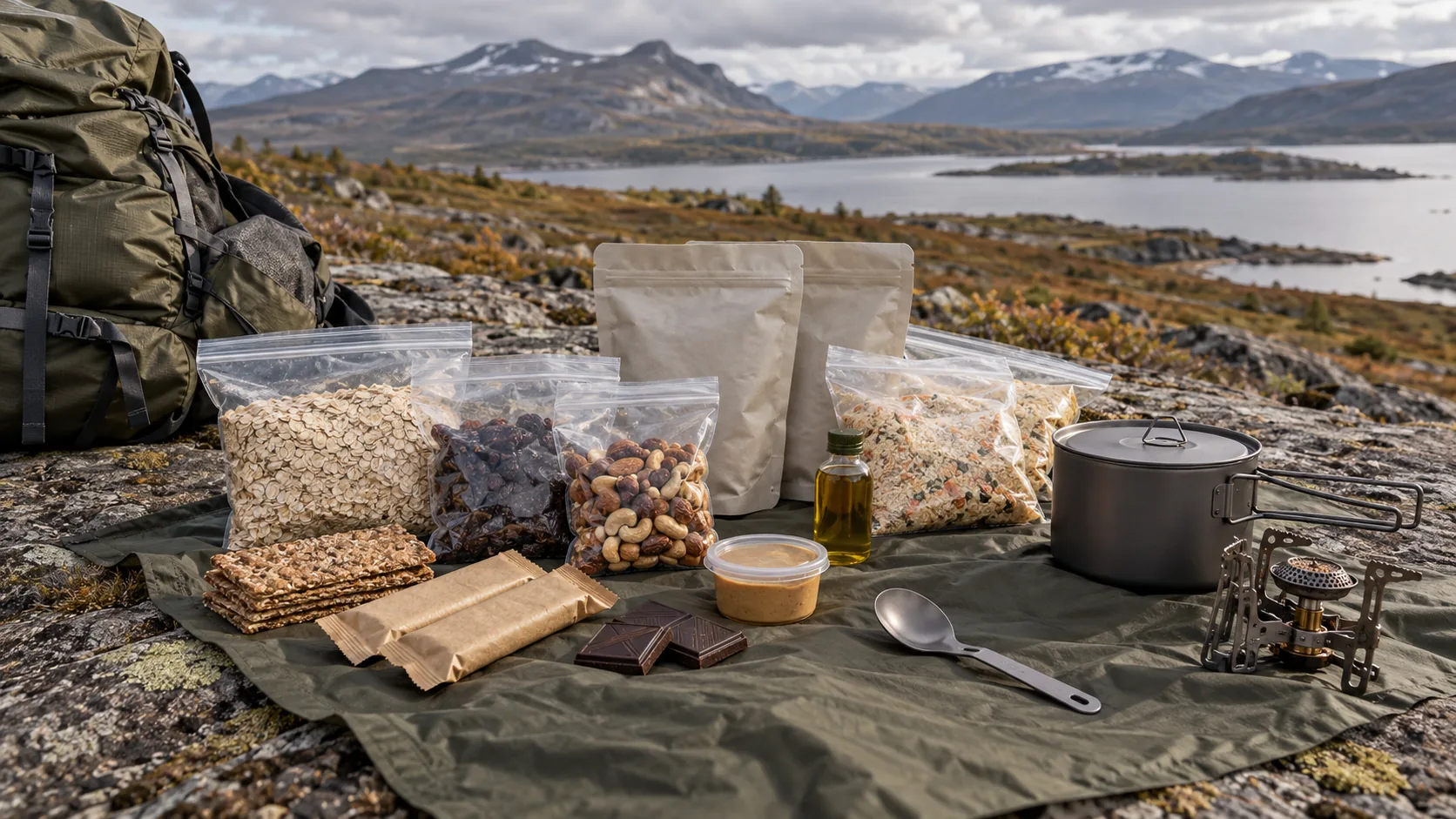
The table below is a worked example, not measurements of particular products or a balanced diet for everyone. The values per 100 g are rounded assumptions, deliberately cautious in a few places: many cereal bars and freeze-dried meals contain more calories. When you shop, replace these values with the figures on the labels. Weights are for dry food, without packaging. I explain how to read freeze-dried meal labels further down. All the calculations that follow are based on this example.
| Meal / item | Weight | Assumed kcal per 100 g | Energy per portion |
|---|---|---|---|
| Breakfast: instant oats | 100 g | 370 | 370 kcal |
| Full-fat milk powder | 30 g | 500 | 150 kcal |
| Raisins for the porridge | 30 g | 300 | 90 kcal |
| During the day: crispbread | 100 g | 350 | 350 kcal |
| Peanut butter | 80 g | 600 | 480 kcal |
| Nuts, split into smaller portions | 80 g | 600 | 480 kcal |
| Cereal bars, total | 120 g | 400 | 480 kcal |
| Chocolate | 50 g | 560 | 280 kcal |
| Dinner: complete freeze-dried meal, dry contents | 150 g | 400 | 600 kcal |
| Olive oil for dinner | 20 g | 900 | 180 kcal |
| Total | 760 g | 3,460 kcal |
Breakfast gives you 610 kcal, daytime food 2,070 kcal and dinner with oil 780 kcal. Split the daytime food into snacks and something more substantial for the longer stop. The ration fits a day like this as it is: the only hot food is porridge and dinner, and on the move you eat things that don’t need cooking. Add only as much oil as your stomach can comfortably handle. If the meal is already fatty, swap the oil for something else and recalculate the total.
On average, the whole ration works out at about 455 kcal per 100 g. That’s a handy yardstick in the shop: a product with noticeably fewer calories will make the ration heavier for the same energy.
This selection includes milk and nuts, among other things, and depending on the products it may contain gluten and other allergens. Substitutes may have a different energy value. Choose a freeze-dried meal that also provides protein, and check the make-up of the whole day’s food. On its own, hitting the calorie total doesn’t mean the diet is balanced.
How much food for a week, and how much for ten days
If every day is like the one in the table, the sums for a week look like this:
| Plan | Food weight without packaging | Energy of all the food |
|---|---|---|
| 7 full days | 5.32 kg | 24,220 kcal |
| 2 spare days | 1.52 kg | 6,920 kcal |
| 9 rations in total | 6.84 kg | 31,140 kcal |
On a longer route without resupply, the numbers go up. For ten days I allow two spare days, twelve rations in all:
| Example: 10 days without resupply | Food weight without packaging | Energy of all the food |
|---|---|---|
| 10 full days | 7.60 kg | 34,600 kcal |
| 2 spare days | 1.52 kg | 6,920 kcal |
| 12 rations in total | 9.12 kg | 41,520 kcal |
With a pack that weighs, say, 20 kg (44 lb) at the start, the food alone for ten days in this example comes to nearly half of that. So work out and weigh your own rations before you go.
Packaging, water, gas, the stove and the pot all come on top of the food. If you’ll be collecting water along the way, don’t count water for every meal as a fixed weight. Do plan how much you need to carry between sources and how you’ll treat it. I cover this in my guide to water in the wilderness.
You don’t have to eat the same thing all week. Put together two or three tried-and-tested breakfasts and a few dinners, then work out each day separately. If you swap the nuts for the same weight of dried fruit, the calorie content of the whole ration changes. A note saying ‘760 g a day’ isn’t enough if you change the products.
Freeze-dried meals or ordinary supermarket food
Freeze-dried meals are convenient: measure the water, pour it in and wait as long as the maker says. But check whether the label gives energy per 100 g, per serving or per pack. Then look at the weight: is it for the dry product or the meal ready to eat? Some manufacturers give both. ‘Serves two’ doesn’t tell you if it will fill two hungry walkers after a full day on the move.
Ordinary supermarket food can supplement the plan: instant oats, couscous, instant mash, crispbread, peanut butter and dried fruit. Before you buy, read the cooking instructions on the packet. Rice that needs a long simmer will use more gas than something you just cover with boiling water.
In your own dinner mix, include a source of protein that will survive a few days in your pack and can be prepared in camp. You can’t make dried pulses edible by soaking them briefly in boiling water. Undercooked red kidney beans can even cause food poisoning, because they contain a lectin that’s only destroyed by boiling hard for a long time.
Choose products that the label says don’t need refrigerating. Check how to store them once opened, too. A cool evening in the mountains doesn’t count as a fridge.
If you’re flying to Sweden from outside the EU, for example from the UK or the USA, you may not bring milk powder or other dairy products, or meals containing meat or milk, in your luggage. That includes many freeze-dried meals. The exceptions include infant milk and special foods needed for medical reasons, up to 2 kg. Buy these items in Sweden. The ban doesn’t apply if you’re travelling from another EU country or from Norway, Iceland or Switzerland.
How much gas to take for a week’s trekking
How to work out how much gas you need
A simple rule of thumb from the stove maker MSR is enough: each hot meal or hot drink means roughly one litre of water to boil. Count a hot meal that doesn’t need boiling water as a litre anyway, because the stove usually runs for about as long. Allow extra for meals that need longer simmering and for any water you treat by boiling.
Then weigh the canister, boil a litre of water in your trip pot with the lid on and weigh the canister again. If your stove uses, say, 16 g a litre, and every day you make porridge and dinner, which is 2 litres by the MSR rule, a week with two spare days comes to:
16 g × 2 × 9 = 288 g of gas, before you add hot drinks and a margin for difficult conditions.
Cold weather, melting snow and wind can mean using three to four times as much fuel, and very cold water from glacial streams takes longer to boil.
I don’t cook meals myself. I only boil water and pour it over a freeze-dried meal, oats, coffee and tea. That way one canister with 450 g of gas lasts me ten days. How much gas you’ll use depends on your stove, the wind and the water temperature, so base your figures on your own test.
The gas weight on the label isn’t the weight of the whole canister. A full canister holding 230 g of gas can weigh more than 350 g. So add the weight of the canister itself to your kit list.
Travel, buying gas and the cold
Gas canisters (butane, isobutane, propane) aren’t allowed on passenger flights, in either hand luggage or hold luggage (the bags you check in). Carry gas for the whole route from the start. If there’s a shop or a hut along the way, don’t build your plan around it, because it may run out of canisters. On a cold night you can put the canister in your sleeping bag or a jacket pocket, always unscrewed from the stove. Never warm a canister with a flame, next to a fire or in boiling water: manufacturers say it must not be exposed to more than about 50 °C, because it may explode or start to leak. If you smell gas, take the canister out of the tent. In a separate guide to gas canisters for trekking, I explain how to transport a canister, where to buy one when you arrive and how gas behaves in the cold.
Stove safety
Do not use a windshield with a stove that screws straight onto the canister, unless the maker of that model expressly allows it. Inside a windshield the canister can overheat, which can lead to a gas leak or an explosion. Light the stove outside, never in the tent or the porch, because of the risk of carbon monoxide poisoning and fire. There’s more detail in the guide to gas canisters.
Pack your rations and test them on a trial walk
Divide your food into days or clearly labelled meals. Keep the information on allergens, best-before dates and how to prepare each item. If a meal is meant to be rehydrated in its own pouch, don’t tip it into any old bag that can’t take boiling water.
Check the oil bottle doesn’t leak and put it in a second bag. Keep dry food away from moisture. Make sure some of the spare food can be eaten without cooking.
Where brown bears live, for example in Sarek, stick to a few rules in camp: cook and eat away from the tents, pack food in odour-proof bags and take your rubbish with you. I say more about this in my guide to brown bears in Sarek, and about setting up camp without leaving a trace in my piece on wild camping.
Before you go, put together a full day of food from your plan and take it on a longer walk. In the evening, cook dinner in your trip pot. Measure the water you need, note the cooking time and judge the portions.
Checklist before you shop and pack
- days on the trek counted separately from travel to the start and back
- spare food for delays packed separately, with some of it edible without cooking
- calories checked on the label: per 100 g, per serving or per pack
- for freeze-dried meals, weight checked: dry product or ready to eat
- gas use measured by weighing the canister, with a margin for cold and wind
- the whole canister, not just the gas, included in your pack weight
- gas for the whole route carried from the start: a canister from home or one bought locally if you’re flying
- oil in a leakproof bottle inside a second bag
- food in odour-proof bags, with rubbish packed to carry out
- a full day’s food eaten on a trial walk, dinner cooked in your trip pot
Enter your revised food list and the actual packaging weights in the SavaliGear pack planner. You’ll then see what you’re really carrying on day one.
If you’d like to head into the wild with me, take a look at my expeditions or write to me.
Frequently asked questions
How much food should I take for one day’s trekking?
A rough guide is 2,500–4,500 kcal per person per day, or about 0.7–1.1 kg (1.5–2.5 lb) of food. In my example it’s 760 g and about 3,500 kcal. Test your own ration on a two-day trial.
How many days of spare food should I carry?
Base it on the weather, river crossings and how easy it is to leave the route. I allow one spare day for every four or five days on the route. For a week, and for ten days, I take two spare days.
How much gas do I need for a week’s trekking?
By the MSR rule of thumb, each hot meal or drink means about a litre of water to boil. Weigh the canister before and after boiling a litre. At 16 g a litre, porridge and dinner for nine days come to 288 g of gas, with no margin for cold or wind.
Freeze-dried meals or ordinary supermarket food?
Both. On a freeze-dried meal label, check if the calories are given per 100 g, per serving or per pack, and if the weight is for the dry product. From the supermarket, choose things you only need to cover with boiling water, because they use less gas.
Can I cook in the tent porch?
No. Light the stove outside, away from the tent fabric, and do not cook in the inner tent or in the porch. Burning gas in an enclosed space can cause carbon monoxide poisoning, and the flame can set the tent on fire. Where there are bears, also cook away from the tents.
Back to tips