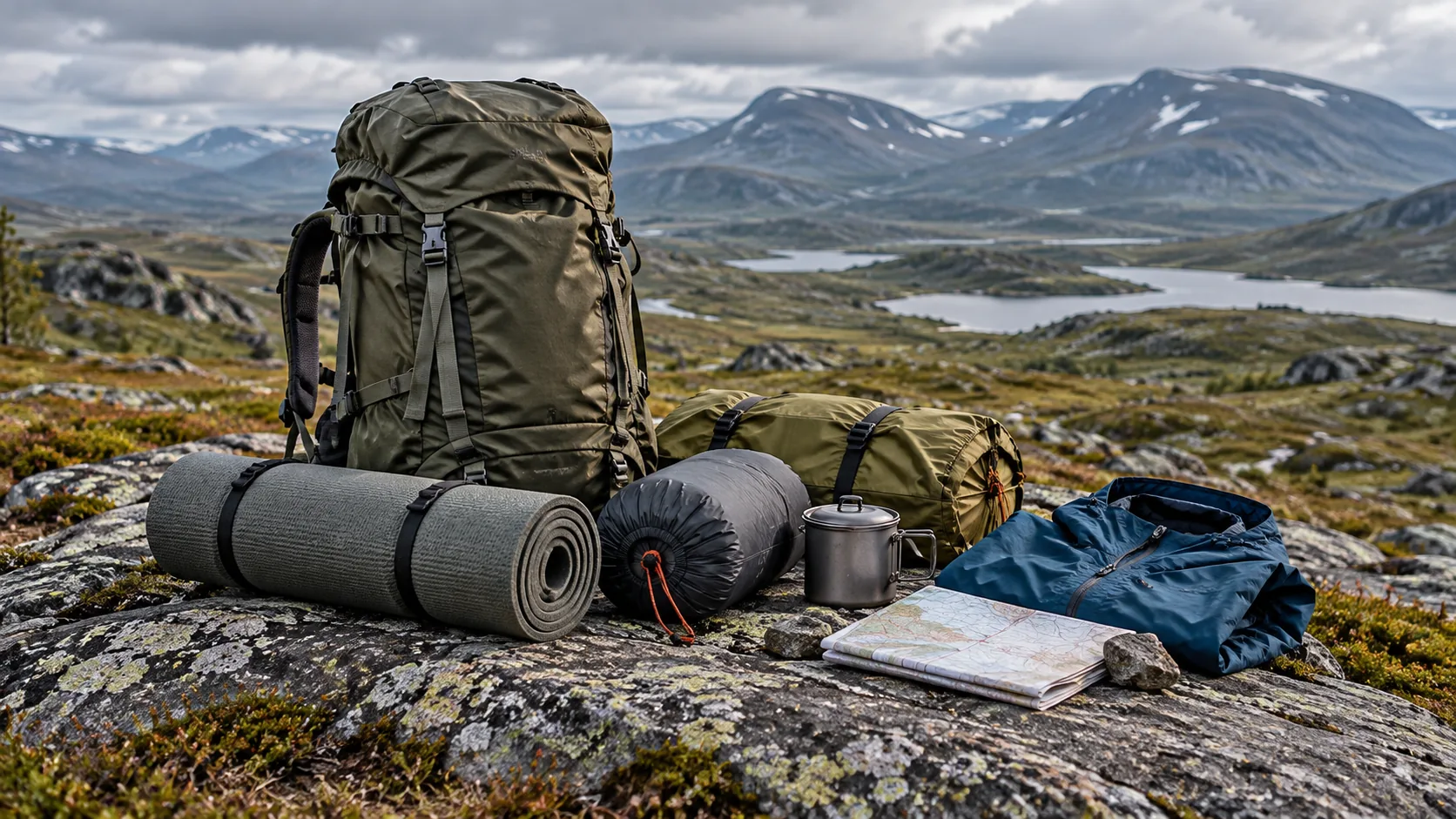
The first multi-day trek with a tent is the moment when most people pack either too much or too little — they rarely hit the middle. After years of walking the Swedish mountains I have come to see that what you leave at home is often more important than what you take with you. Below is my list — without excess and without gaps.
Shelter and sleep — without these there is no trek
The tent is one of those things on which it is not worth saving. For a few days of trekking in changing conditions you need a proper three-season tent, with solid pegs and good ventilation: the vapour from your breath at night can be a bigger problem than the cold from outside. Choose a sleeping bag for the temperature in which you will actually sleep: in Sarek, even in August and September, night-time temperatures can drop to −5 °C, and a strong wind makes it feel colder still. For conditions like these, go for a bag with a comfort rating of −5 °C or lower. What counts is the comfort rating, not the limit rating.
Underneath, an inflatable sleeping mat with a good R-value, at least 4–5, which is the kind of insulation that really cuts you off from the cold, damp ground. I also put a folding (Z-fold) foam pad under it, and I suggest you do the same: during the day you can sit on it, it gives you something to sleep on if the mat gets punctured, and it adds warmth from below. The ground in these regions is hard, wet and considerably colder than it seems when you step into the tent, and saving on what you put under yourself is a classic beginner mistake.
The sleeping bag, the inflatable mat and the Z-fold foam pad together should weigh no more than two to three kilograms. This limit assumes a down sleeping bag; with a synthetic one it will come out heavier. The advice on synthetic insulation instead of down, in the clothing section below, applies to the jacket you walk in, not to the sleeping bag. I count the tent separately: I choose one that weighs no more than two kilograms, and I recommend the same. You will feel every extra kilogram on the climbs, especially towards the end of the day.
Clothing — the rule of three layers
A proven set is a thermal base of merino wool or synthetic, in the middle a jacket with synthetic insulation (such as Climashield or PrimaLoft) and on top a wind- and waterproof jacket, preferably with a membrane. In damp terrain such as Sarek, a down jacket will get wet and lose its insulating power, so if you bring one at all, keep it as an extra for camp and never wear it on the move. To complete it trekking trousers and separate waterproof trousers, also membrane — in Lapland this is not a luxury but a basic, because the rain can fall for hours, and wading through wet brush or rivers without them ends with being soaked from the waist down. A hat and gloves also go into the pack, even in the middle of summer.
Take three or four pairs of synthetic socks, because synthetic fibre dries faster than merino. Keep one pair in a waterproof bag and wear it only at night. Add a separate set of clothes for sleeping, which you do not use while walking: nothing improves the mood in the tent like dry clothes in the evening.
Cotton stays at home. Wet cotton chills the body faster than the rain itself and does not dry on the body in any reasonable conditions.
Kitchen and water — the minimum that works
For cooking, a gas stove with a large canister, a one-litre pot, a spoon and two lighters are entirely enough: one in the pocket, the other packed separately, because lighters have a way of breaking exactly when they are needed most. Do not use a windshield with a stove that screws straight onto the canister, unless the maker of that model expressly allows it. A canister enclosed by a windshield can overheat, which can lead to a gas leak or an explosion. For water, a filter or disinfection tablets: the sources in the mountains often look crystal clear, but that is not enough to drink without any safeguard.
Base your food on freeze-dried meals, nuts, energy bars and porridge for breakfast. Count calories for the whole day rather than by kilometres walked, because your body uses energy even when you are not walking. In practice the total comes out a good deal higher than you would expect when planning at home. I show how to work out a daily ration, spare food and the gas you need in my article on trekking food.
Navigation, safety, communication
A topographic map and a compass are basic equipment, regardless of whether you carry a GPS and a charged phone. The first-aid kit should be simple but complete: bandages, blister plasters, a disinfectant, a foil blanket, basic painkillers. To this a whistle, a head torch and spare batteries. If you are going into terrain without coverage, add a satellite communicator — I travel myself with a Garmin inReach and to anyone who heads into the mountains alone I recommend exactly the same.
Checklist — twelve points to check before leaving
- Tent — tested at home, with a complete set of pegs
- Sleeping bag chosen by its comfort rating, not its limit rating (in Sarek −5 °C or lower)
- Inflatable sleeping mat with an R-value of at least 4–5, plus a Z-fold foam pad underneath
- Thermal base, synthetic insulating layer, membrane jacket and waterproof trousers
- Three or four pairs of synthetic socks, one of them for sleeping only
- Stove, large gas canister, pot, spoon and two lighters
- Water filter or disinfection tablets
- Food for the whole trip plus spare food: one spare day for every four or five days on the route (for a week I take two spare days)
- Topographic map and compass
- First-aid kit (bandages, plasters, disinfectant, foil blanket, medicines)
- Head torch with spare batteries and a whistle
- Satellite communicator, if you are entering terrain without coverage
What to leave at home
A heavy photographic tripod, an expanded first-aid kit calculated for thirty people, spare clothes taken ‘just in case’ (a dry set for sleeping is a different matter: that one always comes with you), a hardback book. A sensible pack weight depends on your kit, your build and how many days of food you carry: the longer the route without resupply, the more food you carry from day one. So rather than sticking to a single threshold, go through the contents once more before you set off and ask yourself what you will really use.
The first trek with a tent is, to a large extent, learning through your own mistakes. It is better to take a little too little than to carry unnecessary weight for a week. And if something is really missing — you will remember it much better than any list.
Back to tips